"Strike and Recoil" Day Trading Strategy – Live Morning Session
Morning Session with the Professor
Youtube video from March 26th, 2026
The Strike and Recoil Strategy
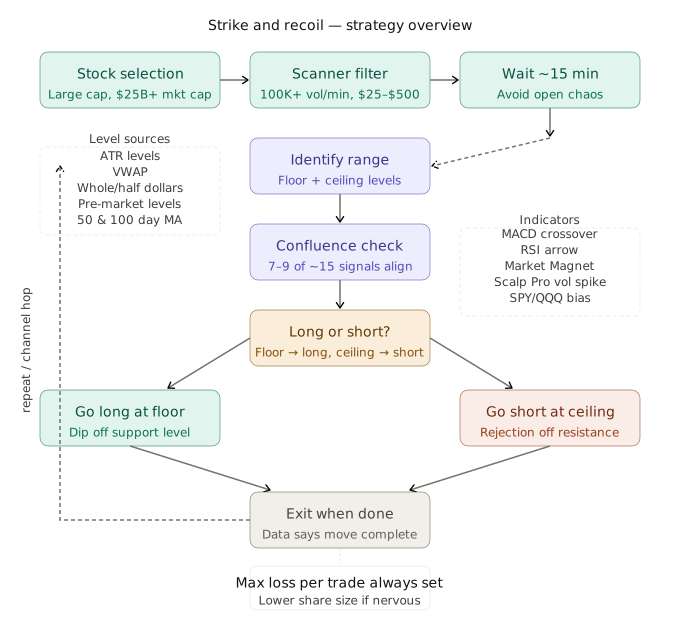
The core strategy is designed for large-cap stocks only (market cap $25B+). The idea is to identify a stable price range with a clear floor and ceiling, then scalp 10–15 cent moves repeatedly throughout the day. The "strike" is a sharp price movement, and the "recoil" is catching the reversal — not the momentum move itself.
The professor explicitly distinguishes this from momentum trading (buy high, sell higher). Instead, you're waiting for overextension and catching the snap back. He trades on a one-minute chart, which he acknowledges feels fast to outsiders but slow to tick-chart traders.
Why Large Caps
Large-cap mega-cap stocks (Intel, Amazon, Nvidia, Tesla, AMD, etc.) are preferred because:
- News cycles rarely affect them dramatically
- They consolidate in predictable ranges
- Liquidity is high — you can get in and out without slippage killing you
- They move slowly enough for a one-minute chart to feel manageable
He notes this has gotten harder recently because of constant White House news disrupting even the most stable large caps.
The Current Market Problem
This is a recurring theme in the video. He states that right now:
- Historical data is almost useless — every few minutes new information out of the White House can instantly reprice the entire market
- Fundamental analysis is useless for the same reason
- Day bias calls are unreliable — he's working on a script to predict the first hour's direction but admits it was below 50% accuracy, which he calls "worse than flipping a coin"
- His workaround: focus exclusively on very short-term intraday levels — floors and ceilings identified just from the past couple of days of price action, not weeks or months
The Tool Stack
He uses the thinkorswim platform (Charles Schwab) with a suite of custom-coded indicators, many available at his "Million Dollar Margin Club":
Custom scanners:
- Scanner 1: Stocks priced $25–$500, minimum 100K volume per one-minute candle
- Scanner 2: Stocks priced $25–$400, ATR over 3, minimum 10K volume per candle, must move at least 15 cents within one minute on Level 2
- Scanner 3: Stocks priced $25–$200, market cap over $2B (mid-cap), minimum 50K volume per candle
Price level indicators:
- ATR levels (Average True Range, 14-day, based on Wilder's formula): automatically marks the whole, half, and quarter ATR levels above and below the current price. He notes the half-ATR is typically the most respected level
- Whole and half dollar psychological levels — gray lines across the chart marking round numbers, because retail traders cluster stops and exits at these levels
- Pre-market high, center, and low — automatically marked
- A 5-candle smoothed range indicator showing average move distance and optimal target (e.g., "go for 6 cents up, risk 3 cents down")
Momentum/volume indicators:
- Scalp Pro Meter — shows when current candle volume exceeds the prior candle; fires an audible ding. Also shows internal candlestick activity to gauge strength
- Market Magnet — a volume profile tool showing where the bulk of capital is sitting. When price moves away from it, it tends to snap back like a rubber band. He compares watching the magnet "come in like a big python" as a setup trigger
- Buy/Sell Oscillator arrows — green arrows for RSI oversold (go long signal), red for overbought. He notes RSI is less reliable than MACD pre-market
- MACD (based on EMA crossovers) — he considers this more reliable than RSI, especially during regular market hours. The indicator displays arrows directly so you don't have to interpret the histogram
- VWAP (Volume Weighted Average Price) — the red line representing where the bulk of the day's capital is. Overextension from VWAP tends to revert. He compares price to VWAP like a rubber band being stretched
Moving averages used:
- 9 EMA
- 50-day moving average
- 100-day moving average He notes that on a one-minute chart, these day-based averages become very significant support/resistance points
Share Size Philosophy
This is probably the most emphasized concept in the entire video:
"The key to all of day trading is what can you mentally handle."
If you feel nervous and can't play out the move you identified, your share size is too high. Period. Lower it until you can execute without emotional interference.
His rules:
- If you have $25K in your account, don't use the 4x margin the broker gives you. Stay under margin — that's your first restriction on share size
- Trade the same dollar amount you have. $25K account = trade with $25K, not $100K
- He calls his group "Tortoise Traders" — slow, steady, consistent small wins
- Monthly goal: $2,200 (average US mortgage) = $120/day. He was at $2,500+ by the time of this recording with many trading days left
Two-for-One Risk/Reward Debate
He pushes back hard against the universal "always risk half of what you aim to gain" rule taught on most trading YouTube channels. His argument:
- Real traders exit when the data says the move is done — when indicators say the move has completed, that's when you take profit
- The 2:1 rule exists because most traders can't control themselves emotionally, so it's a safety guardrail imposed from outside
- He recommends: Tom Hougaard's Best Loser Wins and Mark Douglas's Trading in the Zone as books that treat this more honestly
Trading the Open
He trades the open for fun (self-described "adrenaline rush") but explicitly does not recommend it:
- Never trade the first one-minute candle — market orders need to wash out
- It's essentially a gamble — no reliable data yet to establish range or direction
- He references Day Trading Volume 4 by the Million Dollar Margin Club for statistical breakout patterns if you insist on trading the open
- He keeps share size tiny at the open (25 shares on Tesla in this video, vs. potentially 100+ later)
His preferred entry: ~15 minutes into the session, once a consolidating pattern has formed
Stop Loss and Stop Hunting
He warns against predictable stop placement:
- Big firms and algorithms can see clustered stop levels on the chart
- They will deliberately push the stock down to those levels, trigger the stops, scoop up the shares, and let price immediately recover — classic stop hunting
- His advice: use price alerts on your phone rather than hard stop-loss orders at obvious levels. Or place your stop above/below levels that aren't where everyone else is
Live Trades This Session
AMD: Biggest trade of the session
- Entered long after it appeared on the scanner (ARM chip news drove it up sharply)
- Used VWAP, 50-day MA, and Market Magnet confluence as floor
- Scaled in cautiously, took partial profits
- Eventually caught a Strike and Recoil short near the 100-day MA high
- Also caught a recoil on a late big spike upward
- Total session: ~$174+ (well above the $120 daily goal)
Amazon: Secondary candidate
- Had catalyst news (acquiring Farasis Robotics, affecting Tesla narrative)
- Showed consolidation after 15 minutes; VWAP, ATR high, and Market Magnet confluence for potential range
- Volume dropped below 100K — too slow, abandoned it
Tesla and Intel: Briefly considered at the open, ultimately not traded
The "15 Data Points" Framework
He mentions he's working on a video about this but teases the concept: before taking a trade, try to line up as many of the ~15 indicators/confirmations as possible. If you can get 7, 8, or 9 of them pointing in the same direction, the probability of the trade working dramatically improves. The more confluence, the better. He rattles off several he looks for simultaneously:
- VWAP direction/position
- Market Magnet signal
- RSI arrow
- MACD EMA crossover
- Volume on current candle vs prior candle
- ATR level proximity
- Whole/half dollar psychological level proximity
- Pre-market levels
- Overall market bias (SPY and QQQ direction)
- 50-day and 100-day moving averages
- Level 2 bid/ask spread and momentum
- Candlestick patterns (dragonfly, doji, three black crows, flat top, etc.)
Candlestick Patterns Referenced
He references Day Trading Volume 2: The Candlestick Pattern Playbook as his recommended resource, which rates patterns by reliability. Specific patterns mentioned during the session:
- Dragonfly (one-minute)
- Doji (indecision)
- Three black crows (bearish)
- Rick Shaw Man (top reversal)
- Flat top (potential resistance/ceiling)
- Tweezer bottom (potential floor)
- Bull flags and bear flags (his personal favorites)
Swing Trading (Mentioned)
He holds swings separately from scalps, on a different Charles Schwab account:
- Currently holding Nvidia long swing, targeting ~$190, entered around $179
- Apple swing: exited for a small profit after hearing negative news, didn't want to hold through uncertainty
- Plans to start publicly calling all swing trades next month alongside the scalp sessions
Account Structure / Sessions
He runs three trading sessions daily:
- Morning (this video) — small share size, open to all viewers
- Afternoon — sometimes (depends on meetings)
- High share size session — restricted to registered members
He also does "quarterbacking" — calling potential trades for other traders. Since he's unlicensed, he can't be paid formally for advice, but he calls it out live and lets people decide
Accuracy Stats Shared
- Running 80–90% accuracy overall this month
- Best days: 100% accuracy
- Worst day: 42% accuracy
- Second worst: 63%
- All other days: 80–100%
- Monthly P&L at time of recording: $2,500+ (goal was $2,200)
- Yesterday's session: $300
He shows his trade log daily and encourages viewers to verify rather than take his word for it, and repeatedly reminds viewers he is not a licensed financial advisor.
A few other notable points worth highlighting:
On cherry-picked trading gurus: He's pretty blunt that most YouTube traders showing "calls" are working from historical charts — not live. Anyone can point to a chart after the fact and say "buy here, sell there." His differentiator is that he trades live every morning with a real account, shows his daily P&L log, and invites scrutiny.
On gambling vs. trading: He addresses the "it looks like gambling" criticism directly. His answer: every trade is probabilistic, but you're stacking as many data points as possible in your favor before entering. It's not a coin flip if you have 8–9 signals pointing the same direction. The goal is to create a better probability, not a guarantee.
Channel hopping: When a stock breaks out of its established range (floor/ceiling), it doesn't necessarily trend — it often finds a new range at a higher or lower level. Recognizing this shift and quickly re-identifying the new floor/ceiling is called a "channel hop," and knowing when to accept it (vs. holding and hoping) is a key skill.
The surfboard metaphor: He describes his approach as sitting on a surfboard waiting for a wave, then riding it briefly in the direction it's already going — not fighting the ocean, just catching short bursts of directional momentum within an established range.