How to start swing trading
New Youtube video from PricePlanProfit for beginners
From A-Z for beginners or failing traders who need a fresh start
How to Start Swing Trading From Scratch (Step-by-Step)
This video breaks down swing trading for beginners in a no-fluff, structured way. The presenter outlines five core steps to get started:
1. Set Up Your Tools You only need three things: a charting platform (she uses Thinkorswim), a broker (Schwab or Interactive Brokers), and a trading journal. The journal is non-negotiable — it builds the discipline that keeps you profitable.
2. Learn the Core Strategy She focuses on just three things per trade:
- Trend direction — Is the stock above or below its 50/200-day MA? Also look at whether it's making higher highs/higher lows (uptrend) or lower highs/lower lows (downtrend). If it's in an uptrend, you're looking to buy the dip. If it's in a downtrend, you're looking to sell the rip — or stay away entirely.
- Pullback to demand or support — Never chase a stock that's already run up 20%. Wait for it to pull back to a support/demand zone for longs, or bounce up into a supply zone for shorts. This is where you buy calls (uptrend) or puts (downtrend).
- Confirmation — Wait for a strong green candle from the demand zone with increasing size, signaling buyers are stepping back in. She has a dedicated 3-step confirmation process she references separately.
3. Manage Your Risk Three hard rules:
- Never risk more than you can afford to lose on a single trade — on a $5,000 account, max risk per trade should be $500.
- Always set your stop loss before entering the trade, not after. If the stop criteria is met, exit and move on — no second-guessing.
- Only take trades with at least a 2-to-1 reward-to-risk ratio. If your stop is $2 below entry, your first target must be at least $4 above. If the math doesn't work, skip the trade.
4. Build Your Watch List
- First, determine the overall market trend using the S&P 500. If the S&P is in an uptrend, only look for stocks also in uptrends and only trade the long side. If the S&P is in a downtrend, only look for stocks in downtrends and trade the short side.
- Then go to koifin.com to identify which sectors are outperforming the overall market.
- Once you find the strongest sectors, dive deeper to find the individual standout stocks within those sectors.
- Narrow your final list down to 5–6 quality names for the week. Quality over quantity — 2 to 5 good swing trades per week is plenty.
5. Build a Routine
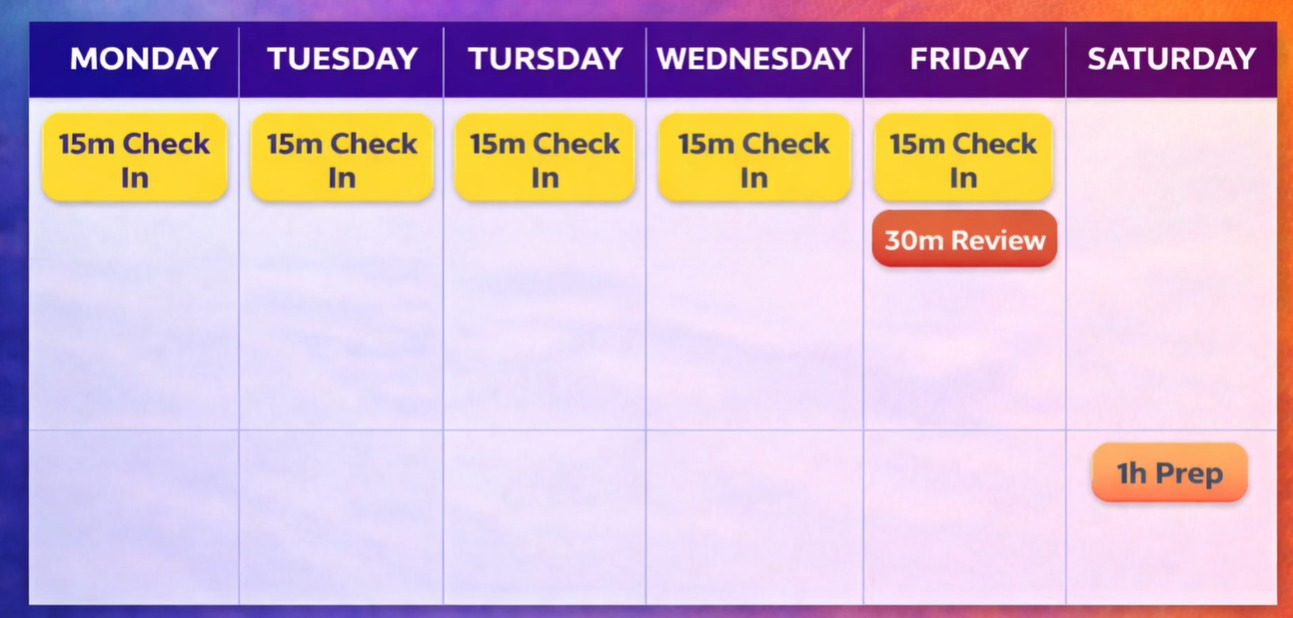
- Friday evenings — Run scans and build a potential watch list for the coming week.
- Saturday mornings — Set detailed trade plans, narrow the list to 5–6 names with defined buy/sell zones, stops, and targets.
- Monday–Friday mornings — Focus on day trading during the first hour of the market.
- After the first hour — Check the swing trade watch list to see if any setups have reached their buy zones or sell zones. If they have, drop to a smaller timeframe chart and wait for confirmation before entering.
- Daily — Journal before the market opens, during trading hours, and after the close.
- Friday evenings — Review the trade journal and assess any open swing trades.
Total time commitment: roughly 1 hour of prep per week plus 15 minutes of journaling per day.
Bottom line: Swing trading isn't about secrets —